





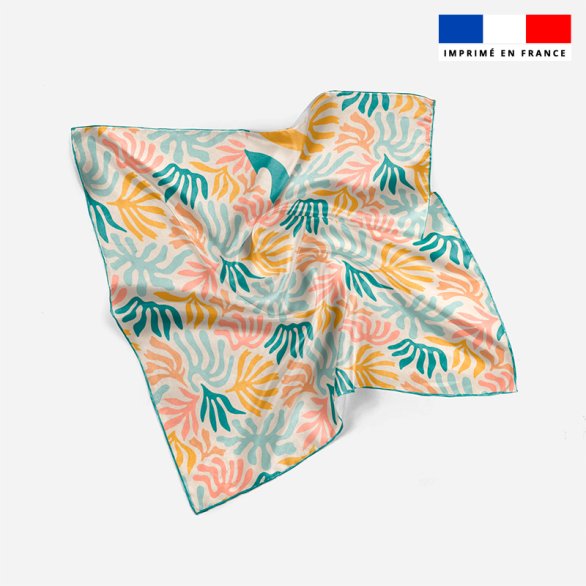



The same file printed on cotton, polyester or faux leather will never produce exactly the same result. The reason is simple: each material has its own composition, texture and ability to absorb inks. This is why each fabric family is printed using a specific textile printing technology: sublimation, direct pigment printing or Latex inks.
You may have noticed that the same design printed on several textile substrates does not have exactly the same colors or feel. Yet the digital file is identical. This difference is perfectly normal: it is explained by the composition of the fabric, the way the inks penetrate (or do not penetrate) the fibers, and the printing technology used. Here is a simple explanation of why each textile behaves differently during printing.
Textile printing depends above all on the substrate
Unlike paper, whose properties are standardized, textiles do not all have the same physical characteristics. Printing on fabric therefore naturally depends on the chosen substrate.
Each material has:
- a different composition (natural fibers such as cotton or linen, synthetic fibers such as polyester, coated surfaces such as PVC);
- a different texture (smooth, woven, textured, velvety);
- a different base color (the “white” of polyester satin is not the same as the white of a cotton canvas);
- a different ink absorption capacity.
As a result, two fabrics receiving exactly the same digital file will rarely produce an identical result. It can be compared to painting: painting wood, metal or concrete with the same can of paint will never produce exactly the same result because each material reacts in its own way.
To understand the fundamentals of the process, you can consult our guide everything you need to know about textile printing.
Each fabric family has its own printing technology
At Tissus Print, several textile printing technologies are used to achieve the best possible result depending on the fabric. Each process has been developed for a specific family of materials.
| Material | Technology used | Why? |
|---|---|---|
| Polyester | Sublimation printing | Polyester fibers bond perfectly with dyes in gaseous form. |
| Cotton | Direct-to-fabric printing (pigment inks) | Pigments are deposited directly into natural fibers. |
| PVC / Faux leather | Latex printing | Latex inks adhere to coated surfaces without damaging them. |
There is therefore no universal machine capable of perfectly printing every textile. Each process is optimized for a family of materials, with its own inks, temperatures and color settings.
Why is polyester printed using sublimation?
Sublimation consists of transforming ink into gas through heat (around 200 °C). Once gaseous, the dye penetrates directly into the polyester fiber and then becomes permanently fixed as it cools. The ink does not remain “on” the fabric: it becomes part of the fiber.
Result:
- very vivid and bright colors;
- excellent wash resistance;
- no difference in feel: the fabric retains all its flexibility;
- long-lasting printing, resistant to friction and UV exposure.
One essential point: this technology only works on polyester fibers or fabrics containing a high proportion of polyester. On pure cotton, sublimation dyes have no fiber to bond to.
To discover the process in detail, see the detailed steps of sublimation printing.
Why is cotton printed differently?
Cotton is a natural fiber of plant origin. Its cellulose structure is very different from that of polyester: the dyes used for sublimation cannot penetrate it.
Direct-to-fabric printing is therefore used, with pigment inks sprayed directly onto the fabric. The pigments remain fixed in the fibers thanks to a specific fabric treatment (pre-treatment) followed by heat fixation.
The result of cotton printing is:
- slightly more matte than sublimation;
- very natural, in harmony with the appearance of the fiber;
- ideal for cotton textiles: poplin, canvas, cotton gauze, jersey…
This does not mean the result is “less good”: it is simply a technology adapted to the material. A matte and soft appearance is actually perfectly suited to the character of natural fibers.
Why do PVC and faux leather use Latex inks?
PVC and faux leather present the opposite problem: they absorb practically no ink. Their surface is closed, coated and waterproof. Conventional ink would slide off or flake.
Latex inks, which are water-based and contain polymers, are specifically designed to adhere to this type of substrate. Under heat, they form a flexible and durable film on the surface of the material.
They provide:
- excellent adhesion to coated surfaces;
- high resistance to wear and friction;
- flexible printing that follows deformations of the substrate;
- long-lasting colors, including for intensive use (leather goods, furniture, tablecloths).
Why do colors change from one fabric to another?
This is probably the most common question about fabric printing. Even when the file is identical, several factors influence the final perceived color.
| Element | Influence on color rendering |
|---|---|
| Fabric composition | Different ink absorption depending on the fiber |
| Printing technology | Different dyes and color spaces |
| Substrate color | Whites that are warmer or cooler depending on the material |
| Fabric texture | Different light reflection |
| Finish (matte or satin) | Changes how colors are perceived |
Take a practical example. A bright red printed on:
- polyester satin will appear very bright, almost vivid;
- cotton canvas will appear slightly softer and more matte;
- faux leather may appear somewhat deeper.
The file has not changed. It is simply the natural difference between cotton, polyester and PVC printing.
Fabric texture also affects the result
Light does not reflect in the same way from every textile. Our perception of color is directly influenced by this light reflection.
For example:
- cotton poplin has a smooth and even surface;
- canvas is more textured, with a visible grain;
- velvet diffuses more light and softens shades;
- satin fabric reflects more light and intensifies colors.
With identical ink and files, this reflection changes our perception of colors. It is an optical phenomenon, not a printing defect.
The inks are different depending on the technology
Not all textile inks work in the same way. They include:
- sublimation inks (disperse dyes activated by heat);
- pigment inks (pigments fixed on the surface of natural fibers);
- Latex inks (polymers forming an adhesive film).
Each ink family has:
- its own chemical composition;
- its own fixing method (penetration, impregnation or surface film);
- its own color space, meaning the range of colors it can reproduce.
This is another major reason for differences in appearance: some shades that can be reproduced through sublimation on polyester are physically beyond the range of pigment ink on cotton, and vice versa.
Can exactly the same color be achieved on all fabrics?
The answer is simple: no. Even with highly precise color management (ICC profiles, regular machine calibration), it is impossible to achieve an absolutely identical reproduction on different materials. The physics of fibers and inks makes this impossible.
However, a professional textile printer calibrates its machines to achieve the best possible result on each substrate. At Tissus Print, each printing technology is specifically adjusted for the fabric concerned, ensuring optimal textile printing quality and colors that are as faithful as possible to the original file. This focus on color management is part of our Made in France textile printing expertise.
How do you choose the right fabric for your project?
The choice depends above all on your final use, not on the technology itself.
| Project | Recommended fabric |
|---|---|
| Sportswear | Sublimated polyester |
| Shirt, lightweight clothing | Cotton poplin |
| Interior decoration | Canvas, cotton, velvet |
| Bag, leather goods | Faux leather |
| Outdoor banner | PVC canvas |
The goal is therefore not to find “the fabric that prints best”, but the one that is best suited to your project. If you are still hesitating between the main approaches, our article fabric printing vs textile printing: which option should you choose? will help you decide.
Discover all our textile customization solutions: DTF printing, direct-to-cotton printing, sublimation and much more.
Discover textile printing
Conclusion
Each textile has its own characteristics, and each textile printing technology – sublimation, direct-to-cotton printing, Latex inks – is developed to make the most of these specific properties. This is why the same design can show slight variations in color or appearance depending on whether it is printed on cotton, polyester or PVC.
These differences are not printing defects, but the natural result of the composition of the materials and the processes used. By choosing the technology suited to each substrate, it is possible to achieve a durable, accurate and high-quality result, whatever your textile project. To learn more, discover our complete guide: everything you need to know about fabric printing.
Frequently asked questions about printing differences between fabrics
Why doesn't my design have exactly the same colors on two different fabrics?
Because each fabric absorbs and reflects inks differently, and each printing technology uses inks with different color spaces. These variations are normal and inherent to textile printing, even with an identical file.
Can cotton be printed using sublimation?
No. Sublimation dyes only bond to polyester fibers. On pure cotton, they do not penetrate the fiber and would disappear after the first wash. Cotton is printed directly using pigment inks.
Does Latex printing adhere to faux leather?
Yes, that is precisely what it is designed for. Latex inks are formulated to adhere durably to closed and coated surfaces such as PVC and faux leather while remaining flexible.
Which technology produces the brightest colors?
Sublimation on polyester generally produces the brightest colors because the dye becomes integrated into the fiber itself. However, each technology provides the best possible result for its specific material family.


0 commentaires