














How to understand textile certifications
To really understand textile labels (OEKO-TEX, GOTS, recycled, etc.), you only need to know what they actually guarantee, why they exist, and how they apply to your custom textile printing projects.
With marketing messages, unfamiliar logos and technical jargon everywhere, it’s normal to feel lost. At Tissus Print, we support creators, organisations and French brands every day who simply want to make the right choices. Here is a clear, straightforward guide to understanding textile labels, with no unnecessary technical talk and no greenwashing.
Why are there so many labels in textiles? (and why it’s normal to feel lost)
Fashion is one of the most polluting industries in the world. Faced with environmental and social challenges, numerous certifications have emerged to regulate practices and reassure consumers.
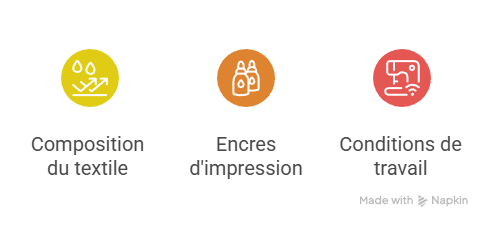
The issue? All these labels do not certify the same thing. Some control the composition of the textile, others check the printing inks, and others focus on working conditions for employees. A customer may think that a single label is enough to call a product eco-friendly, but that’s not always true.
The goal of this guide is simple: to help you understand that one label = one specific promise. Once you’ve grasped this logic, everything becomes clearer.
The 3 main families of textile certifications
To simplify things, we can group certifications into three main categories. Each one addresses a different concern.
1. Health and safety certifications (no harmful substances)
These labels guarantee that the product does not contain dangerous chemicals for skin or health. They check for heavy metals, pesticides, allergenic dyes, and more.
Example: OEKO-TEX Standard 100
2. Ecological and organic certifications
Here, the focus is on the environmental impact of production: organic farming, eco-friendly dyes, water management, waste treatment, as well as respect for human rights.
Example: GOTS (Global Organic Textile Standard)
3. Recycling and second-life certifications
These labels confirm that part or all of the textile comes from recycled materials, such as plastic bottles transformed into polyester (rPET) or cotton made from production offcuts.
Example: Recycled polyester / rPET
OEKO-TEX Standard 100: the best-known label, but often misunderstood
What OEKO-TEX guarantees (simple explanation)
The OEKO-TEX Standard 100 label checks that the textile contains no harmful substances for human health. It tests more than 100 criteria on the finished product: heavy metals, formaldehyde, pesticides, carcinogenic dyes, phthalates, etc.
Key points:
- The control is carried out on the finished product, not just the raw materials.
- Suitable for clothing, accessories, home textiles and printed textiles.
- It is a guarantee of safety for the skin, particularly important for children and sensitive skin.
What OEKO-TEX does NOT guarantee
OEKO-TEX does not certify that the textile is organic, that it was produced in an environmentally friendly way, or that workers were treated fairly. It is purely a health and safety label.
GOTS: the organic (and ethical) textile label
What GOTS guarantees
GOTS (Global Organic Textile Standard) is the leading label for organic textiles. It goes far beyond the simple absence of harmful substances.
Here’s what GOTS guarantees:
- Organic cotton: at least 70% certified organic fibres.
- Controlled dyes and inks: no heavy metals or toxic products.
- Water treatment: strict obligations for managing wastewater.
- Social criteria: respect for workers’ rights, decent wages, safe working conditions.
GOTS is the most comprehensive label in the textile market. It covers both environmental and ethical aspects.
What GOTS does not guarantee
GOTS only applies to natural fibres such as cotton, linen or wool. It cannot certify polyester, even when recycled. In addition, obtaining GOTS certification is more expensive and requires a fully certified supply chain from start to finish.
Recycled fibres: what do they really guarantee?
Recycled polyester / rPET
Recycled polyester (also called rPET) is made from used plastic bottles or textile production offcuts. Instead of ending up in the ocean or landfill, this waste is turned into quality textile fibres.
Advantages:
- Reduces plastic waste.
- Lowers the use of oil needed to produce new polyester.
- Ideal for sublimation printing (high-quality visual results).
- Strong, lightweight and durable.
What you need to know
A recycled textile is not necessarily organic. Recycling plastic is still a positive approach, but it doesn’t turn it into a natural fibre. However, a recycled textile can also be OEKO-TEX certified, which guarantees it is safe for the skin.
Recycled polyester is widely used in the following sectors: sportswear, bags and luggage, promotional merchandise, textile décor.
This type of material is offered at Tissus Print on a selection of promotional textile items in recycled polyester, customisable on demand for useful, visible and more responsible branded goodies.
Simple table: comparison of recycled materials
| Type | Advantages | Ideal for |
|---|---|---|
| Recycled polyester | Strong, eco-conscious, lightweight | Sports, bags, décor |
| Recycled cotton | Highly eco-friendly, soft | Sustainable fashion, basics |
| Printed rPET | High-quality sublimation | Goodies and complex visuals |
Additional social and environmental labels
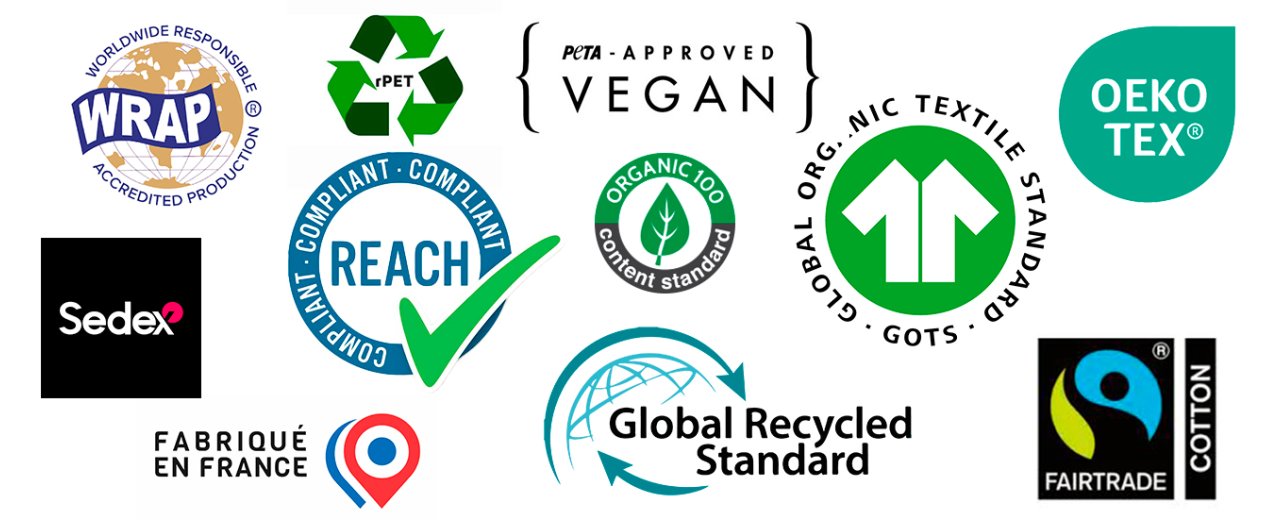
Beyond OEKO-TEX and GOTS, other certifications help build a responsible textile offer. Here are the main ones to know.
FairTrade (Fair trade)
Guarantees that cotton producers and textile workers receive a fair wage and work in decent conditions. FairTrade focuses on the human aspect of production.
WRAP (Worldwide Responsible Accredited Production)
International certification that audits textile factories on safety, working conditions and respect for human rights. Less known to the general public, but widely used in the industry.
REACH
European regulation governing the use of chemicals across all sectors, including textiles. A REACH-compliant product meets European Union safety standards.
PETA Approved Vegan
Certifies that no animal-derived components have been used in the textile (no wool, leather, silk, etc.). Ideal for vegan brands.
How labels do (or don’t) apply to textile printing
Many customers think that if a textile is certified, the finished product automatically remains certified. That’s not always the case. Here’s why.
Textile certifications vs ink certifications
Some certifications apply to the textile itself (the T-shirt, the tote bag, etc.), others to the inks used for printing, and others still to the entire production chain. If one link in the chain is not certified, the final product loses its certification.
The economic reality of certifications (let’s be honest)
To be fully transparent: obtaining and maintaining certifications is expensive. Certification bodies charge for regular audits and, in some cases, if a textile passes through several countries, the certificate has to be renewed in each one. These administrative costs can amount to several thousand euros per year.
This creates a vicious circle: these costs are passed on to the final price. If buyers are not prepared to pay a little more, suppliers won’t certify their textiles. And yet, a non-certified textile is not necessarily low quality. In many cases, it meets OEKO-TEX or GOTS criteria, but the supplier has simply not paid to obtain the official label.
This is why at Tissus Print, we work with trusted suppliers and make every effort to list all their certificates. Even when a textile does not display an official logo, we check its composition and traceability.
Certifications and price: understanding the cost of transparency
Let’s talk money, because that’s often the key question. Why does a GOTS-certified T-shirt cost more than a standard T-shirt? The answer is simple, but worth explaining.
The real cost of certifications
International certifications such as GOTS or OEKO-TEX involve:
- an initial audit of the company,
- mandatory annual audits,
- licence fees,
- sometimes additional checks when several countries are involved in production.
These processes represent a fixed cost for manufacturers and processors.
The longer the production chain, the higher the cost.
Why this affects the final price
When a textile is certified, this administrative cost is added to the price of the material, transport and processing. This is why a certified textile is generally more expensive than an equivalent non-certified textile.
It’s not an extra cost linked to the quality of the fabric itself, but to the cost of the control process.
Non-certified ≠ poor quality
Some suppliers produce textiles that are:
- compliant with OEKO-TEX or GOTS criteria,
- but without an official certificate.
This may be a financial choice: if they mainly sell to a market that doesn’t demand these labels, they simply don’t pay for certification.
So non-certified doesn’t mean “non-compliant”: it simply means the manufacturer has not gone through the administrative process.
A question of volume, not goodwill
The more demand there is for certified textiles, the more volumes increase, which allows certification costs to be spread across a larger quantity.
This explains why some labels are gradually becoming more accessible.
Certifications at Tissus Print (explained simply)
We have selected the most relevant certifications to support your custom textile printing projects. But beyond the labels themselves, our commitment is based on three key pillars.
Our commitment no. 1: local production
This is our core focus. We print in France, in our workshop near Toulon in the Var region. Our small factory, at our scale, allows us to control every stage of production and drastically reduce the carbon footprint linked to transport.
Producing locally also means creating jobs in France, guaranteeing decent working conditions and being able to welcome you into our workshop if you wish. Transparency starts with proximity.
Certified inks and eco-conscious machinery
We use DTF inks certified OEKO-TEX Standard 100 for our short-run printing, guaranteeing the absence of harmful substances. For ethical projects, we also offer GOTS-certified inks for cotton printing.
Our printing machines are chosen for their reduced environmental impact: they use no water in the printing process, unlike traditional screen-printing techniques which can consume several litres of water per print run.
Certified textiles and supplier traceability
Our catalogue includes a wide range of certified textiles: OEKO-TEX T-shirts, GOTS tote bags, products in recycled polyester. We make every effort to list all our suppliers’ certificates and to check their traceability, even when the textiles do not carry an official label.
Other guarantees available in our range
- Eco-friendly promotional items.
- FairTrade products.
- PETA Approved Vegan products.
- REACH-compliant products.
- Materials from recycling.
You are part of the change too
We’re keen to expand our selection of certified and recycled fabrics, but to do that, we need you. Tell us what you’d like to see in our catalogue. It’s important for us to feel that you’re just as committed as we are to this responsible approach.
The more people request certified textiles, the more we can negotiate with our suppliers and offer you fair prices. Together, we can make a real difference.
How to choose the right certification for your project
Every project has different needs. Here is a simple decision table to help you choose.
| Type of project | Recommended label | Why |
|---|---|---|
| Ethical fashion brand | GOTS | Strong ecological consistency and brand image |
| Responsible branded goodies | Recycled polyester + OEKO-TEX | Quality with a reasonable price |
| Beginner designer | OEKO-TEX | Simple, reliable and accessible |
| Premium product | GOTS + local production | Maximum perceived value |
The right certification depends on your budget, your values and the message you want to send to your customers.
Explore our certified materials and launch your responsible textile project today.
Customise your fabric
Conclusion
Understanding textile labels is not that complicated once you know what they really guarantee. Keep these three key points in mind:
- Labels do not all mean the same thing: health, ecology, ethics or recycling.
- Understanding their role helps you make choices that are consistent with your values.
- At Tissus Print, we help you choose with confidence, from fabric selection through to inks.
Whether you’re a beginner designer, a committed brand or an association, we’re here to guide you towards the most suitable solutions for your project.
FAQ
Is OEKO-TEX organic?
No. OEKO-TEX guarantees the absence of harmful substances for health, but does not certify that the textile is organic. For organic textiles, look for GOTS.
What’s the difference between OEKO-TEX and GOTS?
OEKO-TEX focuses on the health and safety of the finished product. GOTS goes further: it certifies organic fibres, eco-friendly processes and respect for human rights throughout the production chain.
Is recycled polyester eco-friendly?
Yes, in the sense that it makes use of plastic waste and reduces the amount of oil needed to produce new polyester. However, it is still a synthetic material and is not biodegradable.
Which certification should I choose for an ethical brand?
GOTS is the most complete label for an ethical brand. It combines ecological criteria (organic cotton, controlled dyes) and social criteria (working conditions). If your budget is tight, OEKO-TEX + FairTrade is a good alternative.
Can you print a GOTS textile with any ink?
No. If you want to keep GOTS certification on the finished product, the ink must also be GOTS certified. Otherwise, the product loses its certification. This is why Tissus Print offers GOTS inks.
Can personalised promotional items be eco-responsible?
Absolutely. Choose recycled polyester certified OEKO-TEX, or organic cotton certified GOTS. Even for small runs, there are now responsible solutions that work for branded merchandise.
Why are some quality textiles not certified?
Obtaining certification is expensive: regular audits, renewal per country in case of international transit, administrative fees. Some suppliers produce textiles that meet OEKO-TEX or GOTS criteria but choose not to pay for the official label. At Tissus Print, we check the composition and traceability of all our textiles, even those that are not certified.
How can I check if a product is really certified?
Each certification has a licence number that can be checked on the label’s official website (for example: oeko-tex.com for OEKO-TEX). Don’t hesitate to ask your supplier for this number.
Why choose a French printer like Tissus Print?
The geographical origin has a major impact on the carbon footprint. Printing in France means reducing transport, guaranteeing decent working conditions and being able to control the entire production chain. Our workshop near Toulon allows us to provide this full transparency.


0 commentaires