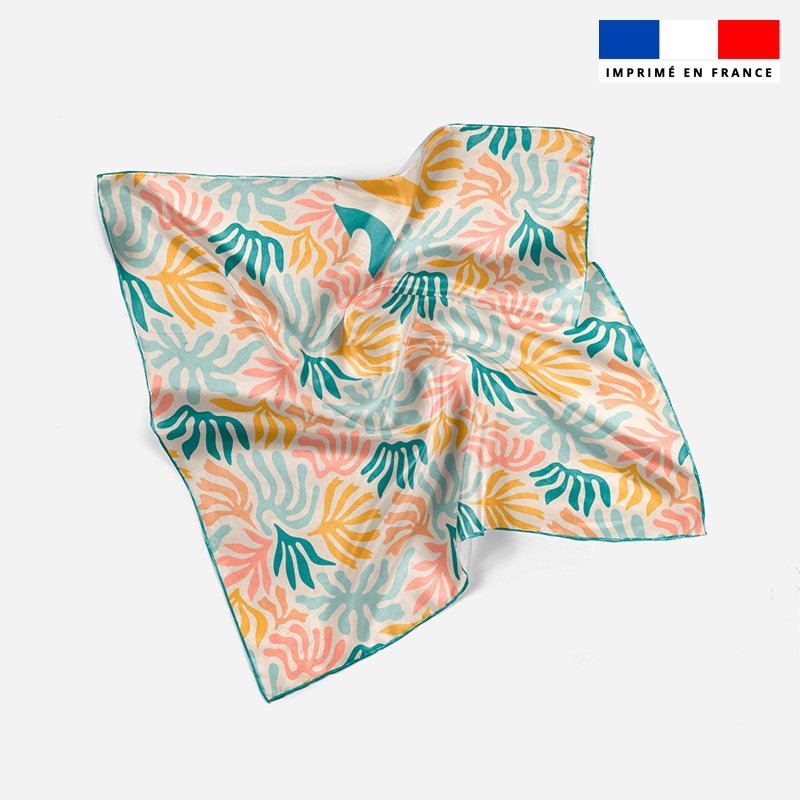
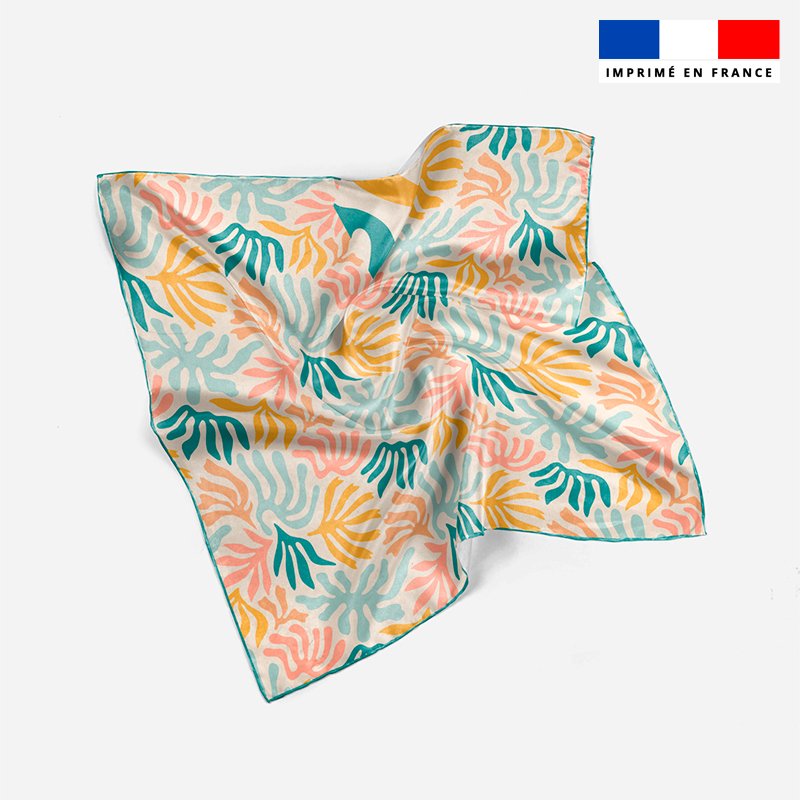
In 2026, the custom scarf stands out as the most strategic textile accessory for brands and businesses. Premium materials, reimagined formats, custom production: here is what defines custom scarf printing this year.

Satin or chiffon: which fabric in 2026?

The choice of fabric determines the entire result in custom scarf printing. In 2026, two fabrics clearly dominate orders: satin, for high perceived value projects, and chiffon, for lightweight and contemporary creations.

Satin as the premium corporate fabric

In luxury hospitality, high-end retail, and front-of-house uniforms, satin has become the benchmark. Its glossy finish provides immediate elegance, and its structured drape makes it easy to wear as a neck scarf, tie, or pocket square. Most importantly, its ability to reproduce colors with remarkable depth and contrast makes it the ideal medium for custom textile printing.

The advantages of satin for custom scarf printing are as follows:

  • Deep, high-contrast color rendering, ideal for complex logos.
  • Smooth surface that enhances sharp graphic details.
  • Structured drape ensuring an elegant and consistent fit.
  • Immediate premium perception, suited to high-end environments.

The most requested formats in custom satin for corporate use are 60x60 cm for structured neckwear and 90x90 cm for maximum versatility.

Chiffon: lightweight and modern for fashion brands

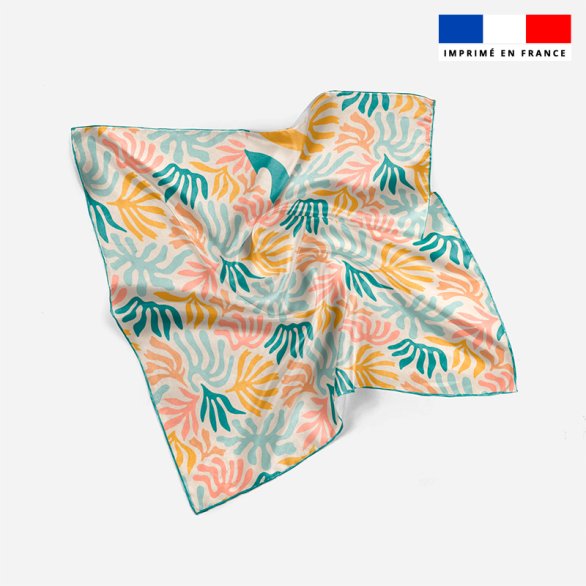
In contrast to satin, chiffon stands out for its airy feel and subtle transparency. Its natural movement makes it particularly popular in the fashion industry, especially for capsule collections, signature scarves, and highly artistic pieces.

In 2026, custom scarf printing on chiffon is especially popular for oversize formats (90x90 and 120x120 cm), which fully showcase the fabric’s natural drape.

Custom chiffon brings a contemporary and creative dimension that satin cannot always offer. For fashion-driven, limited-edition, or artistic projects, it is the preferred fabric.

Satin vs chiffon comparison for custom scarf printing in 2026
CriteriaSatinChiffon
Color renderingDeep, glossy, high-contrastSoft, slightly sheer
DrapeStructuredFluid, airy
Main useCorporate, uniforms, retailFashion, collections, events
Recommended formats60x60, 90x90 cm90x90, 120x120 cm
Suitable printing techniqueSublimation, digital printingSublimation, DTF
Customer perceptionPremium, institutionalContemporary, artistic

Key formats: from 40x40 to 120x120

Choosing the right format is just as important as selecting the fabric. In 2026, the trend is not standardization but segmentation: each format serves a specific use, a defined budget, and a distinct communication objective.

In B2B practice, 60x60 cm and 90x90 cm remain the most commonly selected formats for custom scarf printing, particularly for corporate and event use.

At the same time, there is growing interest in 40x40 cm formats (valued as a discreet accessory) and 120x120 cm formats, which are more aligned with a fashion-forward and expressive approach.

40x40 cm: the mini scarf, a strong trend

undefined

Discreet yet highly visible when styled correctly, the 40x40 cm scarf is gaining strong momentum in 2026. Worn on the wrist, tied to a bag handle, or styled as a belt, it adapts to multiple dress codes. In a corporate strategy, it serves as a premium giveaway with a low unit cost while maintaining a refined brand image.

This format is particularly suited for corporate events, trade show giveaways, and employee welcome kits. Its compact size optimizes digital printing costs while maintaining high-quality graphic output.

60x60 cm: the perfect balance between visibility and budget control

undefined

The 60x60 cm format is often recommended for a first order. It offers enough graphic space to showcase a logo, illustration, or pattern, while remaining easy to standardize in a uniform program. It is the best compromise between visibility, cost efficiency, and adaptability to different body types. Major French hotel chains have made it their standard format for reception uniforms.

90x90 cm: the timeless reference

undefined

The 90x90 square remains, in 2026 as every year, the absolute benchmark for custom scarves. Its generous surface allows full graphic expression, from all-over patterns to centered logos with structured borders. It is associated with institutional elegance and strong brand identity. For custom corporate scarves, it delivers the strongest visual impact.

120x120 cm: oversize as a statement

undefined

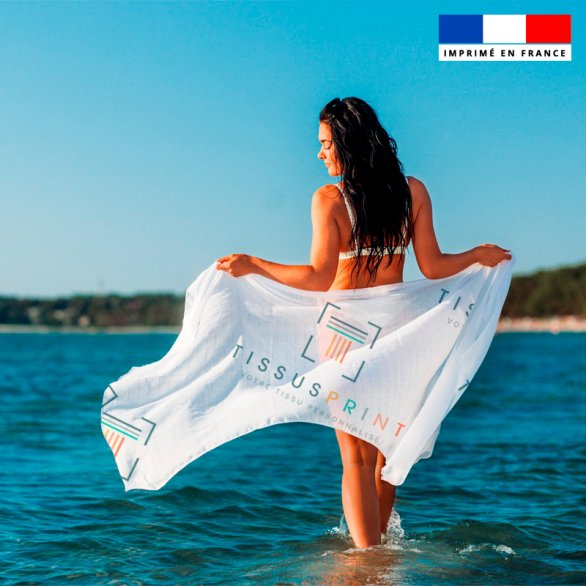
Worn as a shawl, draped like a light cape, or styled as a skirt, the 120x120 cm format is the statement piece of 2026. This oversize format is mainly targeted at fashion brands aiming to create high perceived value pieces, limited editions, and artistic collections. Textile printing on polyester using sublimation is particularly effective here, ensuring consistent color rendering across the entire surface.

The return of the 90x90 square in uniforms

After a few years of being overshadowed by more compact formats, the 90x90 cm square is making a strong comeback in corporate uniform programs in 2026. This trend is largely driven by evolving expectations: companies are no longer looking for purely functional accessories, but for pieces that contribute to overall brand image.

In sectors such as private banking, luxury, airlines, and 4- and 5-star hospitality, the 90x90 satin scarf is now fully integrated into dress codes. It is designed with the same level of graphic care as packaging or campaign visuals.

High-resolution digital printing on polyester satin now achieves levels of detail and color saturation that were unattainable just five years ago. A fabric weight between 100 and 120 g/m² ensures a structured drape without excessive stiffness, ideal for neckwear or pocket styling.

For companies planning to integrate this format into their uniform programs, it is recommended to order a sample before production to validate color rendering on the selected fabric.

The rise of the oversize scarf

The oversize trend is no longer limited to ready-to-wear. In 2026, large-format custom scarves (90x90 and 120x120 cm) are becoming essential across fashion collections, high-end corporate events, and limited-edition artistic projects.

Oversize responds to multiple market dynamics. On one hand, consumers seek versatile pieces that can be styled in multiple ways. On the other, brands recognize that larger formats offer unmatched graphic space, enabling complex illustrations, immersive visual storytelling, and strong editorial messaging.

Sublimation printing on polyester is the most suitable technique for these large formats: it ensures consistent color rendering across the entire surface, without loss of saturation at the edges, and offers superior durability compared to traditional printing methods.

For fashion brands looking to stand out, a well-designed oversize scarf can become a signature piece. Several independent designers have adopted large formats as their signature, working with specialized printers like Tissus Print to achieve quality comparable to luxury fashion houses.

Check out our guide to sublimation printing to understand the technical specifics of this method and choose the right parameters for your project.

Custom production as a strategic lever

In 2026, the real differentiating trend in custom scarf printing is not a format or a fabric: it is the ability to produce made-to-measure. Specific dimensions, adaptation to existing uniforms, unique graphic creation for limited editions: custom production has become a strong strategic argument for brands that reject standardization.

Why custom production dominates in B2B

In a B2B context, companies face constraints that standard formats cannot always address: strict Pantone color guidelines, existing patterns that must be reproduced identically, or collections where scarves must perfectly match other textile pieces. Custom production meets all these requirements.

The concrete benefits of custom scarf printing are numerous:

  • Perfect alignment with brand guidelines, without color compromise.
  • Budget optimization through tailored quotes based on volume and specifications.
  • Adaptation to real-world needs, especially for unconventional formats or specific fabrics.
  • Enhanced brand value through a unique product that competitors cannot replicate.
  • Ability to create numbered limited editions with high perceived value.

How custom orders work at Tissus Print

Create a unique and refined custom scarf with personalized support and options tailored to fashion, corporate, or event projects.

1. Choose your fabric

Select the material best suited to your desired result and use:

  • Satin: smooth and glossy surface, ideal for premium results and vibrant colors.
  • Poplin: soft and structured feel, perfect for a more matte and elegant finish.
  • Chiffon: lightweight and airy, for a fluid and contemporary effect.

Each textile is optimized to ensure excellent print quality and durability.

2. Define the dimensions

Specify the exact size of your scarf based on your project:

  • Square, rectangular, or custom format.
  • Standard or fully customized dimensions.
  • Adaptation to uniforms, fashion collections, or event use.

Custom manufacturing allows precise adjustment to your aesthetic and technical requirements.

3. Select the finishing

Choose the finishing that will define the final look of your scarf:

  • Overlock stitch: visible and structured finish.
  • Rolled hem: refined, premium finish.
  • Simple hem: discreet and minimalist.

Each option ensures a professional and polished result.

4. Add your design

Upload your graphics for full customization:

  • High-resolution files.
  • All-over patterns.
  • Logos.
  • Technical patterns.
  • Production-ready mockups.

A technical check is carried out to ensure file compliance before production begins.

5. Request a quote

Submit your quote request specifying:

  • Material.
  • Dimensions.
  • Finishing.
  • Quantity.
  • Desired lead times.

Our team supports you in defining the most suitable configuration for your custom scarf project, from technical validation to production.

FAQ - Custom scarf printing in 2026

What fabric weight is best for a corporate scarf?

For a scarf intended for uniforms or corporate use, a weight between 100 and 130 g/m² is generally recommended. It provides a structured drape without stiffness, supports high-resolution digital printing, and withstands frequent washing. Below 80 g/m², the fabric becomes too transparent for a professional look; above 150 g/m², it may feel too thick for certain uses.

Can custom scarves be ordered in small quantities?

Yes. At Tissus Print, small batch orders are available, particularly for limited editions, pilot projects, or occasional event distributions. The unit cost is naturally higher than in large volumes, but print quality remains identical. A custom quote helps determine the optimal cost structure for your budget.

To go further, read our article: SMALL BRANDS: HOW TO PRODUCE PRINTED FABRICS WITHOUT MOQ OR FACTORY?

How can I ensure color accuracy between my file and the printed scarf?

Color accuracy depends on two key factors: proper file preparation (ICC profile, CMYK or RGB depending on the technique) and validation of a physical proof before production. For demanding projects with Pantone colors or strict brand guidelines, it is recommended to order a sample on the final fabric before approving full production.

What are the production lead times for custom scarves?

Lead times vary depending on volume, graphic complexity, and material availability. For a standard order (common format, fabric in stock, approved design), expect between 7 and 15 business days after proof validation. Urgent orders or large volumes are handled with dedicated production scheduling, to be specified when requesting a quote.

Is a custom scarf suitable as a corporate gift in 2026?

Absolutely. Custom scarves are among the most appreciated textile promotional items, as they are useful, aesthetic, and durable. In 2026, companies increasingly favor personalized textile accessories over plastic promotional products, aligning with perceived quality and CSR values. A well-designed satin or chiffon scarf is worn and kept over time, making it a long-term visibility asset.

Conclusion: custom scarves as a sustainable textile investment

In 2026, custom scarf printing is no longer just a communication accessory: it is a strategic tool. Whether it’s premium satin to reinforce a hotel brand image, oversize chiffon for a fashion collection, or a 60x60 format to standardize uniforms with elegance, every choice of fabric and format carries meaning.

The underlying trend is clear: brands and businesses are looking for products that deliver on visual promises, align with long-term quality, and can be produced on demand to meet specific requirements. This is exactly what modern digital textile printing enables, with high levels of precision and color accuracy accessible even for small runs.

At Tissus Print, every custom scarf project is treated as a full creative endeavor. Our expertise in digital printing and sublimation ensures results that match your ambitions, from the first sample to final delivery. Ready to bring your project to life? Explore our complete guide to creating a custom scarf from A to Z and move from concept to production.