












Fabric width simply refers to the width of your fabric, measured from one edge to the other. It’s a specification you’ll find on every textile product page, yet it’s often misunderstood — especially by beginners in sewing or anyone ordering custom printed fabric for the first time.
Failing to anticipate the fabric width can result in a pattern being cut off, a sewing pattern not fitting within the fabric width, or a much higher fabric consumption than expected. This guide explains everything clearly and simply.
What does fabric width mean in sewing?
A simple definition
Fabric width refers to the width of a fabric measured flat, from one selvedge edge to the other, before any cutting takes place. It is expressed in centimetres. In practical terms, if you unroll a fabric roll and measure its width from left to right, you obtain its fabric width.
This measurement varies depending on the material: standard cotton fabric is often around 140 cm wide, jersey fabrics can reach 160 cm, while upholstery fabrics may exceed 280 cm.
At Tissus Print, the term “printable width” is also frequently used. This differs from the total fabric width because digital textile printing does not always cover the entire fabric surface. Part of the fabric may be occupied by the selvedges or by technical margins required during the printing process.
Why this term appears everywhere in sewing
Fabric width affects almost every aspect of a sewing project:
- The placement of your sewing patterns on the fabric.
- The amount of fabric required for your project.
- Whether certain pieces can be made without visible seams.
- The consistency of pattern matching and repeats.
A practical example
You are sewing a dress whose pattern requires 140 cm of width. If you order fabric with a width of only 130 cm, it will be impossible to position the pattern correctly. You will either need to alter the cutting layout or order a wider fabric. Just a few centimetres can completely block a sewing project.
Contrary to popular belief, rotating the pattern or design file to save space is not always possible. On fabrics with a grainline or directional stretch, the fabric direction must be respected. For example, on chiffon or stretch lycra, rotating the pattern pieces can completely change the drape of the garment or prevent the dress from stretching in the correct direction. A few centimetres can therefore compromise both the construction and the final result of a sewing project.
How do you measure fabric width?
The measuring method
Fabric width is measured flat, from one selvedge to the other, before any cutting. It corresponds to the raw width of the fabric as supplied on the roll.
Common widths according to fabric type
| Fabric type | Average width | Special features |
|---|---|---|
| Cotton | 140 to 150 cm | Versatile, ideal for clothing |
| Jersey / Lycra | 145 to 160 cm | Stretch fabric, direction must be considered when printing |
| Polyester canvas | 150 cm | Stable fabric, widely used for sublimation printing |
| Satin | 140 cm | Sensitive to pattern placement |
| Velvet | Variable | Nap direction must be considered |
Be careful with the actual printable width
The raw fabric width and the actual printable width are not always identical. Technical margins are required on each side of the fabric to ensure clean digital textile printing. At Tissus Print, these constraints are integrated during file preparation — an important detail that should never be overlooked.
Why is fabric width essential before printing custom fabric?
It impacts your print file
Before launching a custom textile print, your design must be scaled according to the width of the chosen fabric. If your artwork is designed for a width of 150 cm but your fabric is only 140 cm wide, the design will either be cropped or resized in an undesirable way.
It directly affects the cost
A sewing pattern that exceeds the available width by just 5 cm may force you to reposition the pieces, increase the amount of fabric ordered, or even double the required fabric length. For multi-garment production or event collections, this difference can represent a significant part of the budget.
It determines whether certain projects are feasible
Some projects require a minimum fabric width to avoid visible centre seams:
- Extra-wide curtains often require fabric measuring 280 cm or more.
- A round tablecloth requires a width adapted to its diameter.
- A swimsuit or pair of leggings made from printed fabric must respect the fabric direction and width to avoid design misalignment.
- A textile banner or personalised tote bag must be designed according to the actual printable area.
With custom printing, every centimetre matters
Unlike paper printing, digital textile printing — whether sublimation or DTF — does not allow easy correction once the fabric has been printed. Anticipating the fabric width ensures your patterns fall exactly where intended from the very first print run.
Fabric width, usable width and selvedge: what’s the difference?
What is the selvedge?
The selvedge is the finished edge on both sides of the fabric. It stabilises the fabric during weaving or manufacturing. It is included in the total width but is generally not used in sewing because it may be stiffer, have a different texture or contain technical markings.
The usable width: the real workable area
Once the selvedges and technical printing margins are excluded, what remains is known as the usable width — the actual area available for sewing, cutting and printing. This is the measurement that should guide your pattern placement.
Why this confusion causes mistakes
Many people order a fabric listed as 150 cm wide assuming they have the full 150 cm available. In reality, once selvedges and print margins are deducted, the usable width may be several centimetres smaller. The result can be logos cut off at the edges, slightly off-centre designs or pattern matching issues.
Which fabric width should you choose for your project?
For clothing
Most clothing patterns — dresses, t-shirts, shirts, sweatshirts and leggings — are designed for fabrics between 140 and 150 cm wide. Before ordering printed fabric, always check the minimum width indicated on your pattern. Also consider the grainline direction and directional prints.
For textile décor
Decor projects such as cushions, tablecloths, curtains and wall hangings often require wider fabrics. Curtains made from fabric that is too narrow will need a centre seam that disrupts the visual continuity of the design. For this type of project, extra-wide fabrics around 280 cm are often preferable.
For professionals and brands
For production runs, fabric width becomes an economic optimisation factor. A well-sized fabric allows more pieces to fit per metre, reduces waste and simplifies cutting processes, whether manual or automated. At Tissus Print, we support brands in this optimisation from the design phase onwards.
Common mistakes related to fabric width before printing
Ordering without checking the printable width
This is the most common mistake, especially among beginner designers or organisations launching a textile project for the first time. The product page may display the raw width, but the actual printable area can differ. Always verify this before confirming your order.
Forgetting seam allowances and hems
Even if your pattern technically fits within the available width, you still need to account for seam allowances (usually 1 to 1.5 cm on each side) and hems. A pattern that appears to fit tightly may become impossible to sew correctly once these margins are included.
Using an incorrectly sized pattern
A design created without considering the fabric width may appear too small and repeat unexpectedly, be stretched to fill the available width, or be abruptly cropped at the edges if it exceeds the printable area. These problems are easy to prevent beforehand but impossible to fix once the fabric is printed.
Ignoring fabric direction
The grainline — the direction of the fabric threads — influences the structure and drape of a garment. On printed fabrics with directional motifs such as flowers, stripes or characters, placing pieces incorrectly can create an incoherent final result. Beginners often overlook this, yet it is essential for a professional finish.
How to adapt your design file or sewing pattern to the fabric width
Prepare your design at the correct scale
Before exporting your print file, simulate the final result at full scale while taking the printable width into account. A design that looks perfectly proportioned on screen may appear too large or too small once printed onto fabric. Working in real centimetres within your design software is essential.
Anticipate pattern matching
If your design contains repeated motifs, you need to plan how the repeats will align at the seams. A straight repeat (identical motif aligned on both sides of the seam) or a half-drop repeat affects both the required fabric quantity and the placement of pattern pieces. These decisions should be made from the beginning of the design process.
Think about sewing during the design stage
A good textile design cannot be created independently from the final sewing process. Cutting zones, seams and hems must all be integrated into the visual concept. For example, a centred motif on the front of a t-shirt must account for the placement of the pattern piece on the fabric before printing.
Order a sample before final production
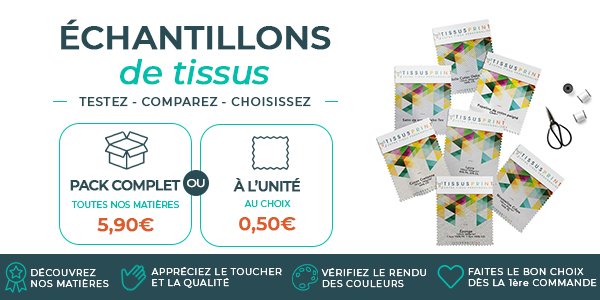
Before launching a full order, ordering a textile sample pack allows you to check printed colours, validate the actual motif size, test the fabric feel and assess sewing behaviour. This step saves considerable time and avoids costly surprises.
Best practices before placing an order
Before sending your file for printing, we recommend:
- Checking the printable width indicated on the chosen fabric product page.
- Including seam allowances when positioning your pattern pieces.
- Testing your file on a sample before large-scale production.
- Checking the actual motif scale in centimetres within your design software.
- Contacting us if you are unsure — our team checks files before printing at no extra cost.
Why technical support makes all the difference
Tissus Print combines textile expertise with sewing expertise. We print in France using calibrated machines that guarantee colour accuracy and precise design placement. If your file presents a width-related issue, we will inform you before printing begins — not afterwards. That is the difference between a successful order and a disappointing experience. Read our file preparation guide to learn more.
In summary
Fabric width is not just a technical detail reserved for professionals. It is a simple measurement — the width of your fabric — but it determines the success of your project from start to finish: pattern placement, motif consistency and the final production cost.
Before ordering custom textile printing, take the time to verify the actual printable width, adapt your file accordingly and order a sample if you have any doubts. A few minutes of preparation can prevent the vast majority of issues.
And if you are unsure, the Tissus Print team is here to support you — from fabric selection and file validation through to delivery of your fabric printed in France.
Discover our custom printed fabrics made in France, available in various widths to meet the requirements of your sewing patterns, garments, accessories or home décor projects.
Discover custom printed fabrics
FAQ – Frequently asked questions about fabric width
What does fabric width mean in sewing?
Fabric width refers to the width of a fabric measured from one selvedge edge to the other. It is the transverse dimension of the fabric roll, expressed in centimetres.
What is the difference between fabric width and fabric size?
Both terms refer to the same thing: the width of the fabric. “Fabric width” is the technical term commonly used in the textile and professional sewing industries.
How can I find the printable width of a fabric?
The printable width is specified on the fabric technical data sheet. It is slightly smaller than the raw width because margins are reserved along the edges for digital printing. If unsure, contact your supplier directly.
Why is fabric width important for sewing patterns?
A sewing pattern must fit within the width of the fabric to be cut correctly. If the width is too small, some pattern pieces will not fit and you will need to alter the layout or increase the amount of fabric ordered.
What fabric width should I choose for curtains?
For curtains without a visible centre seam, it is best to choose a fabric whose width is at least equal to the width of your window (taking gathering into account). Fabrics measuring 260 or 280 cm wide are often used for this purpose.
What fabric width is needed for printing a large motif?
This depends on the size of your design. If your artwork is 130 cm wide, you will need a fabric with a printable width of at least 130 cm, excluding margins. Prepare your file to match the exact dimensions of the chosen fabric.
Is the selvedge included in the fabric width?
Yes. The fabric width includes the selvedges on both sides. However, selvedges are generally not used in sewing and are not part of the printable area. This is why the usable width is always smaller than the raw fabric width.
What is the standard width of cotton fabric?
Standard cotton fabric is usually between 140 and 150 cm wide. This width is compatible with the vast majority of standard clothing sewing patterns.
Can you print across the entire fabric width?
No. Technical margins must be respected along the edges during digital textile printing. The actual printable area is therefore slightly smaller than the raw fabric width. Always check with your printing provider before preparing your file.
How can I avoid placement errors before textile printing?
Create your file using the exact printable dimensions, include seam allowances in your planning and order a sample before approving large-scale production. These three steps are enough to prevent most common issues.


0 commentaires